Sunday, August 7, 2011

Boston Museum of Fine Art--Chihuly: Through the Looking Glass

Wow, I can't describe how beautiful this exhibit of art glass was. I'm thinking I can find some inspiration in the gorgeous colors and shapes. Maybe you can too. (I'll be posting more pictures of the exhibit over the next few days.)

These first pictures come from a room where the ceiling was made of clear glass and was filled with Chihuly's glass sculptures. The light coming through the pieces of glass literally made them glow. They were indescribably stunning.


Let me know what you think.

Thursday, August 4, 2011

Global Patterns: Dress and Textiles in Africa (Boston 2011)--Continued

This is my second installation about the Global Patterns: Dress and Textiles in Africa exhibit I got to view at the Boston Museum of Fine Arts in July of 2011. The exhibit is available through January 8, 2012.

Adire cloths are the work of women artists in towns such as Abeokuta and Ibadan. Women produce, merchandise, and ultimately wear the cloths. Adire translates as “resist,” a reference to the dyeing technique. The women create patterns on plain white cotton by tying or tightly stitching it, or by hand-painting parts of the cloth with cassava paste, so that the fabric will “resist” the dye. In one technique, men cut the patterns into thin metal stencils and apply the cassava paste, before women dye the cloths in large vats of natural or, more recently, synthetic indigo.
This is a shot of the full piece. (The color in the full shot is closer to what it really looked like than the color in the close up.) You can't tell in this picture that the center is made up of tiny intersecting lines. This design is made by stitching on the cloth before the dyeing is done. It is beautiful; the camera just doesn't do it justice. The indigo color is scrumptious! In the picture below, you see a close up picture of the middle and one side of the piece. You can see the tiny lines making up the center of the cloth and the tiny circles in the border. After having tried shibori for one of our techniques for the "And Then We Set It On Fire" blog, I have a whole new appreciation for fabrics such as this.
I would think the piece below would have had to use the stencils mentioned in the opening paragraph. This is a full shot of the piece. You can see a close up below that. (The color in the full shot is more true than the close up.)
This man’s hat (laket lishaash ingyeeng) is from the 20th century and is made of raffia which has been coiled and embroidered with raffia pile. “In the past, all adult Kuba men wore small conical coiled hats with four projections or “ears.” This hat is a variation of the type, for a second cap with moto sits on top of the lower one. Rows of embroidered pile embellish the dome and the “ears.” Among the Bushoong, the leading group in the Kuba kingdom, this hat was the emblem of two important titleholders in a village, the mbeem and mbyeeng. Kuba men still wear these caps, a symbol of Kuba identity for rituals such as funerals.”
This woman’s headdress (mpaan) is from the 20th century and is made of wool, burlap, raffia, glass beads, and cowrie shells. “During ceremonies, senior Kuba women wear headdresses decorated with cowrie shells and beadwork. The valuable materials and distinctive shapes indicate that the wearer has achieved wealth, a high rank, and a titled position in the multiethnic Kuba kingdom. In the 1920s and 1930s, such hats garnered attention in Paris, where the avant garde was fascinated by black culture, including African and African American art, music, dance, and design."
"The embroidered pile cloths of the Kuba peoples of the Congo probably influenced the designer of this ribbon. Kuba textiles were brought back to Europe by Belgian colonials and found their way into the marketplace and private collections. The ribbon is a literal interpretation of Kuba cloth, in its pattern and technique. Here, the pile is machine woven only into specific sections of the cloth, mimicking the more flexible technique of embroidery used by Kuba artists." I just loved the flow of this design.
This beaded figure is made of glass beads, cloth, and string. It was made in the early 20th century. “Artists in the Ekiti area of northern Yorubaland created colorful figures to be displayed in palaces and presented as gifts to foreign visitors by Yoruba rulers. This work evokes the dress and compartment of a “woman of honor,” who carries a child on her back. She wears a blouse and a skirt, both indicated by dark blue rings. Her cock’s-comb hairstyle resembles the coiffures of elegant Yoruba women in the nineteenth and early twentieth centuries." I have a true appreciation for all things beaded. I once made a small beaded Halloween bracelet from a kit. It took me a really LONG time and wasn't all that much fun to do. I can't imagine beading a piece of art like this.
This man’s kente cloth is from the 20th century. “The man who made this masterful wrapper wove squares and rectangles of similar sizes in each strip. When the bands were stitched together, they created a blue and white grid. The elegant red and white designs along the wrapper’s sides results from the addition of supplementary wefts (horizontal yarns) to create further patterns and introduce color.”
This is another piece of kente cloth. I couldn’t photograph the information about this one because of the glare from the display case.
All quoted material came from the Boston Museum of Fine Arts Global Patterns: Dress and Textiles in Africa exhibit.

Tuesday, August 2, 2011

Global Patterns: Dress and Textiles in Africa (Boston 2011)

I recently went to Boston, where I had the opportunity to catch a couple of great exhibits. In this post, I will concentrate on the “Global Patterns: Dress and Textiles in Africa exhibit. “The exhibition highlights continuities, innovation, and the exchange of ideas from within and without that characterize dress and textile production in Africa. Part of the exhibit focuses on just a few traditions: indigo resist dyed “adire” cloths from Nigeria, intricately strip-woven “kente” cloths from Ghana, and beaded attire of the Yoruba peoples in Nigeria and the Xhosa and Ndebele peoples in South Africa. Other sections of the show briefly explore African adaptations of European dress and the melding of African styles and global fashions.” It is available for viewing at the Museum of Fine Arts in Boston until January 8, 2012. It is a small exhibit but one worth viewing. Here is a little taste of the exhibit. (It is hard to get the true feel of the intricasy of the designs unless you can see these picture a little closer. Remember, you can click on the pic and click again to get a real close up.)
This is a bridal ensemble from the 20th century.” It is made of wool and cotton twill blanket, glass beads, cotton thread, cotton canvas, brass, and leather. “Ndebele brides’ beaded attire includes a richly embroidered blanket; a bridal apron; a beaded veil; a neck ornament; neck, arm, and leg rings; and a distinctive train. On their wedding day, brides receive a grass broom with a beaded handle, alluding to their new domestic duties. In older works, such as the train, white beads predominate and geometric motifs are delicate.”
This is a neck ring from the mid-20th century. It is made of glass beads, straw, thread, and metal tacks. “Among the Ndebele, big neck ornaments are characteristic elements of young unmarried women’s ceremonial attire. They consist of straw rings covered with strands of beads. After marriage, copper or brass neck rings replace them, indicating a woman’s new status.”

“Glass beads of European manufacture first arrived in Africa during the sixteenth century, in exchange for gold, slaves, ivory, and other raw materials. Among them were so-called seed beads, which became an important artistic medium, and fostered dynamic changes in fashion.”
This is a cape for a member of the Ogboni society from the mid-20th century. It is made of cloth, glass beads, and three iron attachment rings. “When a male member of the Ogboni secret society wore the cape, a rod was inserted into the top cloth to hold it in place. The Ogboni assembled important townsmen who protected the community by dealing with conflicts that threatened its well-being.”
This is an Ifa diviner’s necklace (ikolaba ifa) from the mid-20th century. It is made of locally woven cloth, glass beads, thread crystals, and nuts. “For the Yoruba, Ifa divination helps individuals—whether commoner or king—gain understanding of the forces that affect their lives. Ifa priests receive years of instruction from older priests, learning to interpret signs and master Ifa’s vast oral literature. When they become persons of wisdom, they are allowed to wear beaded necklaces such as this one.”
This woman’s ceremonial skirt (ntchakabwiin) is from the early 20th century. It is made of raffia plain weave and is embroidered with raffia. The Kuba women embroider plain raffia cloth with loops and cut the stitches to create a velvety pile surface. Their freehand patterns do not rigidly repeat design elements, as necessitated by mechanized looms and printing devices used in Western textile production. Rather, they vary shapes interrupt lines, and combine sharply differing units. This freedom appealed to early-twentieth-century European and American textile designers. They appropriated Kuba patterns, a trend that continues to this day.

I have a few more things to show you from this exhibit. Stay tuned.


Tuesday, July 26, 2011

Frugal and Fancy Quilt Exhibit--Some "Fancy" Quilts

I had the opportunity to attend the Frugal and Fancy Quilt Exhibit at the Indiana State Museum recently. I wanted to share some of the quilts with you.

Whig Rose is an appliquéd quilt made by Lavina Fudicil Rubottom from Franklin County (1845-1865). Lavina is said to have pieced quilts at night by lamp and candle light while waiting for her husband William to come home from work. I sure would have had to have better light than that to appliqué and quilt this masterpiece! Pay careful attention to the elaborate stuffed work in the border. In 1887, the quilt was presented as a wedding gift to relatives.


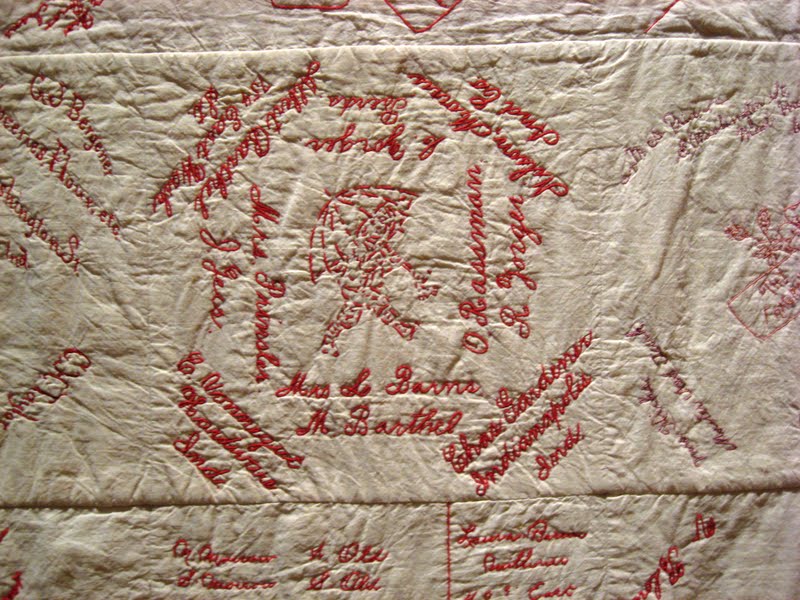
The redwork embroidered signature quilt was made by the Westminster Presbyterian Church Ladies Aid Society, Indianapolis, Marion County (1889). From the 1880s to 1930s, embroidered quilts were a popular way to raise funds. Many well-known Indianapolis businesses or their employees paid to appear on this quilt. A signature from Vonnegut Hardware (owned by author Kurt Vonnegut’s family) and Charles Mayer & Co. appear on this quilt. The finished quilt was presented to the church’s pastor, Rev. Thomas Todd and his wife.

This Crazy Quilt was made by the Grisard sisters of Vevay in Switzerland County in 1884. Zelie Grisard and her sister created an elaborate silk parlor throw to show off their needle skills. If you click twice on this picture to enlarge it, you might be able to find the embroidered Japanese and Kate Greenaway motifs popular in the 1880s and 1890s.
This Amish Nine Patch Variation pieced quilt was made by Lydia A. Yoder of LaGrange County in the 1870s. The simple pattern and rich colors create a striking scrap quilt.
The Pomegranate appliquéd quilt was made by Mary Jane Summers McClellan from Auburn in DeKalb County in the 1850s. This four-block or “quadrant” appliqué quilt is an early style favored before the Civil War.

The most intriguing quilt to me was The Indiania (yes, "Indiania" not "Indiana") Fancy Quilt. It is an appliquéd quilt made by Clarissa Rohrbaugh Strong from Delaware County in 1854. Clarissa was not about to be an “anonymous quilter!” Her masterpiece is named and signed in bold appliquéd letters reminiscent of coverlet weaving or cross stitch. Clarissa Rohrbaugh Strong was born 1813 in Hardy County, in what is now West Virginia. Two years later her family moved to Caesar’s Creek in Greene County, Ohio. On November 18, 1834, she married John Wilson Strong, a farmer. They lived the remainder of their lives near Albany in east central Indiana, where they raised six children. After Clarissa’s death on July 5, 1900, her family lovingly cared for her quilt for another 109 years.
After each word, she has put a period. She names the quilt beginning on the right-hand side and working counter clockwise. I love how she almost runs out of room for her name (check the bottom of the left-hand side) and "squishes" the "G" in.
 The quilting is spectacular, as you can see in this close up shot.
Here is a close up of the lettering. It is all appliqued. Now, that would take a LONG time.

Baskets is a pieced and appliquéd quilt made by Ruth Ann Trinkle of Huron in Lawrence County (1890s-1900). Talk about tiny blocks! Five different blue prints are used to form these itty-bitty baskets. Ms. Trinkle was frugal with fabric but not with her time!
The Dogwood appliquéd quilt was designed by Marie Webster and made by Mary Ann Sipe of Marion County (1940s). Marie Webster of Marion, Indiana, revived quilting in the early 20th century and wrote the first book about it, “Quilts, Their Story and How to Make Them.” Her appliqué designs appeared in the “Ladies Home Journal” and were sold from her home, now the Quilters Hall of Fame. The Dogwood design was published by the Ladies Home Journal in January 1912. I have also included pictures of some of the preliminary work for the quilt.


Thursday, July 7, 2011

I Have Been "Working"--Check Out This Video Series

I have been working on several projects--monoprinting for the "And Then We Set It On Fire Blog" (check that out here--http://andthenwesetitonfire.blogspot.com/2011/07/monoprinting-results-quilter-beth.html), making pieces for my black and white quilt, and embroidering on "Come Dance with Me" pieces.

These next two pieces are part of a black and white quilt I'm planning. I LOVE the spikes!

I have really been enjoying making these tiny yoyos. I'm using the Clover YoYo Maker (shown on the left), which makes them very easy to make. I cut my fabric the size of the "Perfect Circle" shown on the right. The yoyos finish about the size of a dime. The white ones will be used on my black and white quilt. (I may use a couple of the red ones too.) 
Yoyos are a great take-along project and are really easy to make. I'm exploring the incorporation of yoyos into contemporary quilts.

Bird update--I have yet another nest of eggs outside my guest bedroom window from my mourning doves. This will be the third use of this nest this season. The doves have gotten used to me; they don't even fly away when I come into the room. They make me smile!

Lastly, a friend of mine turned me on to Margaret Fabrizio's videos on YouTube. They are quite a hoot. At the current time, she is working on designing a quilt called "Ryoanji." If you'd like to check it out, click on this link--http://vimeo.com/25890805. She has eight videos (to date) following the designing of this quilt. If you are as intrigued as I am by Margaret, check out her website here--http://margaretfabrizio.com/. She is quite a fascinating person.

Let me know what you think. Please leave a comment.

Friday, July 1, 2011

Progress on "Come Dance with Me" and Beginning Another

This is where I was the last time I posted about "Come Dance with Me." Just so you can visualize the piece a little better...it is over five feet tall!
Here is my latest picture showing my progress. These pieces are just pinned up on my design wall.
There are still buttons to add, embroidery to do, stabilizer to tear off, and applique to complete--just on the central character. I'm going to be dragging this entire piece with me when I'm on my travels this month, so that I can get some of that work done. I'm only home a few days all month, and I HAVE to keep making progress on this piece. I still haven't decided what my background will look like. What do you think? Any suggestions?

I have been reading about Pojagi, (also known as Bojagi or Bojaki) and pronounced "Po-Jah-ki." It is a very old, traditional form of Korean patchwork I just learned about on the Internet. One of it’s features is the way the seams are made, enabling both sides of the item to be used. You can see a great video about Pojagi here--http://www.youtube.com/watch?v=Y6tKcWBI6zs. A good tutorial for machine stitched pojagi is here--http://thesillyboodilly.blogspot.com/2010/07/pojagi-machine-stitch-seam-tutorial.html and here--http://www.quiltingdaily.com/media/p/25984.aspx, but I really prefer the hand stitched look. Check here for how to do a hand-stitched version--http://mairuru.blogspot.com/2008/04/how-to-sew-patchwork-furoshiki.html. This piece is just a start. I'm not sure where it will lead me. (You can't really tell from the picture, but the background fabric is a subtle black and blue.) The red pieces are machine sewn into the fabric. I am working on doing some of the blocks using reverse applique (by hand) that I'll add to this section later.

I have in mind doing a series of pieces on domestic violence. This is the start of the first piece. I'm really enjoying the feel of the fabric in my hand. I love the peace that comes to me when I do handwork. That peace is SO contradictory to the feeling of helplessness when a loved one is in a situation that involves domestic violence. I'm sure I'll be working through some long buried feelings when I work on these pieces.